Modernization and software Guide
Custom ERP vs Off-the-Shelf: When to Build, Buy or Extend
For a large company the choice is rarely build or buy. Keep the ERP core standard, buy what your industry already agrees on, and build only what sets you apart, beside the core, where upgrades cannot break it and agents can reach it.
For CIOs, CTOs and CFOs deciding what to do with an SAP, Oracle or Microsoft Dynamics estate before a migration, upgrade or renewal commits the budget.
The short answer
Buy and configure a standard ERP when your processes match industry practice, as finance, procurement and HR usually do. Build a custom system of record only when the process is how you win and no suite can model it. For most large companies the right answer is a third path: keep the ERP core standard and build what differentiates you around it, through APIs, events and agents.
Key takeaways
- Treat custom ERP vs off-the-shelf as three paths: buy and configure, build, or keep a clean core and extend around it. Most enterprises need all three, decided one capability at a time.
- Configuration survives upgrades; modification of vendor code does not. Microsoft no longer supports modifying its code in Dynamics 365 finance and operations apps, and SAP now grades every extension from Level A to Level D by upgrade safety.78
- SAP's mainstream maintenance for the Business Suite 7 core applications, including ECC, ends at the end of 2027, so every SAP migration now forces a decision on each piece of custom code: carry it forward, rebuild it beside the core, or retire it.4
- Compare the paths over five years on eight cost lines. Customization debt, data migration and change are the lines that separate them, so check those first in any business case you are shown.
- ERP vendors now ship MCP servers that let AI agents act under an ERP security role. Extensions built the supported way are the ones those agents can reach, which gives a clean core a second payoff.1112
Most advice on custom ERP versus off-the-shelf is written for a company choosing its first system. A large enterprise starts somewhere else. It already runs SAP, Oracle or Microsoft Dynamics, often several instances, wrapped in two decades of custom code, interfaces and spreadsheets that hold the real process. The live question is which capabilities belong in the standard suite, which deserve software of your own, and where that software should sit so the next upgrade does not break it.
- 54%of 198 German-speaking SAP user companies still used SAP ECC or the older Business Suite, in a 2026 survey1
- 70%+of recently implemented ERP initiatives Gartner expects to miss their original business case goals by 20272
- 35%of 817 builders Retool surveyed had already replaced at least one SaaS tool with a custom build3
Custom ERP vs off-the-shelf: the three real options
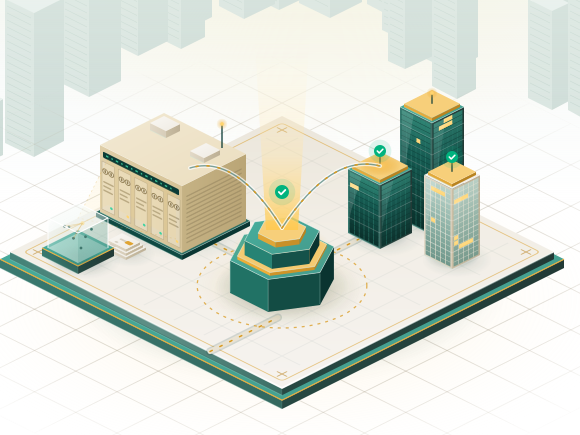
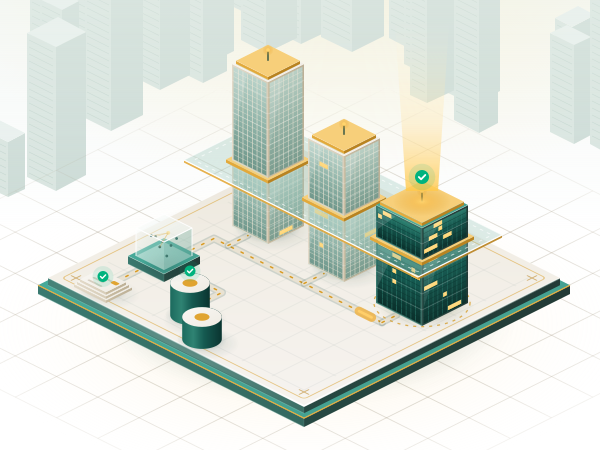
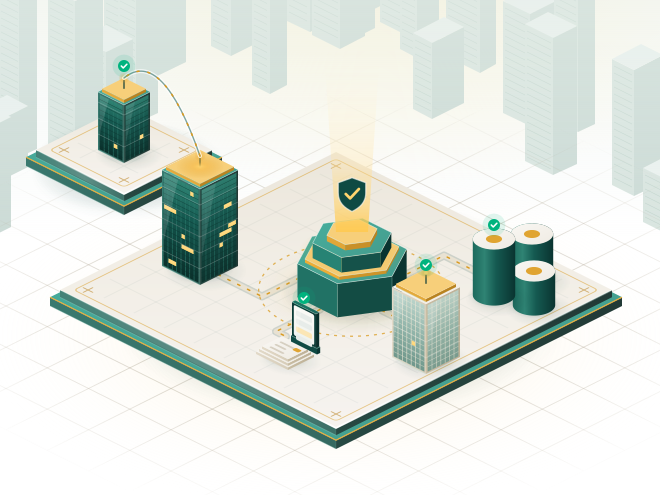
An enterprise has three options for any capability its ERP touches: buy and configure a standard suite, build a custom system of record, or keep the suite's core standard and build what differentiates you around it. The choice is made capability by capability, and most large estates end up using all three. General ledger, payables and payroll are rarely where a company wins. A pricing engine, a production scheduler or a settlement process often is.
Buy and configure
A standard suite, set up with the vendor's own options
- Fastest route to a supported, auditable process
- Upgrades and statutory changes arrive from the vendor
- Your process moves to the product's model
- Differentiation limited to what configuration allows
Build a system of record
Software you own that holds the data and the process
- Fits the process exactly, including what no suite models
- You own the roadmap, the code and the run cost
- Every regulatory change is your team's work
- Justified only where the process is how you win
Extend around a clean core
A standard suite at the center, your software beside it
- Ledger and common processes stay standard and upgradeable
- Differentiating logic runs in apps that call released APIs
- Agents and new interfaces use the same governed APIs
- Needs integration discipline and an architecture owner
Why the ERP decision is live in 2026
The decision is live because SAP's mainstream maintenance for the Business Suite 7 core applications, which include SAP ECC, ends at the end of 2027, and every move off them forces a verdict on the custom code built up around them.4 Oracle E-Business Suite customers have no such clock, so their case has to stand on value alone.6
| Estate | Date | What it means for the decision |
|---|---|---|
| SAP Business Suite 7 core applications, including SAP ECC | End of 2027 | Mainstream maintenance ends.4 |
| The same, on extended maintenance | 2028 to the end of 2030 | Optional, at a premium of two percentage points on the maintenance basis.4 |
| SAP ERP, private edition, transition option | 2031 to 2033 | A subscription for larger, complex systems moved to private edition before the end of 2030, at a higher fee. Not a maintenance extension.5 |
| SAP S/4HANA | End of 2040 | SAP's maintenance commitment for the target platform.4 |
| Oracle E-Business Suite 12.2 | At least 2037 | Premier Support, reviewed each year. No forcing deadline.6 |
The installed base shows the pressure. In the 2026 investment survey of DSAG, the German-speaking SAP user group, 54% of 198 member companies still used SAP ECC or the older Business Suite, down from 68% in 2024 (companies could name more than one system).1 Each of those migrations asks the question this guide answers for every custom object in the old system: carry it forward, rebuild it beside the new core, or retire it.
Customization vs configuration: why changes to the core block upgrades
Configuration uses settings the vendor builds and tests, so upgrades carry it forward; customization adds or changes code, and only code that stays outside the vendor's own survives upgrades cleanly. Microsoft enforces that line in the product: it removed overlayering, the modification of its own code, from Dynamics 365 finance and operations apps. Extensions are the only customization framework, because frequent cloud updates need a customization model that updates are less likely to break.7
| Change | What it is | At upgrade time | Where it belongs |
|---|---|---|---|
| Configuration | Settings and rules the vendor ships and tests | Carried forward by the vendor | Always the first choice |
| In-app extension | Logic or fields attached at extension points the vendor keeps stable | Usually carried forward; regression-tested | Small additions inside the transaction |
| Side-by-side extension | A separate service using the ERP's released APIs and events | Unaffected unless an API it calls changes | Differentiating logic, new interfaces, agents |
| Modification | Changes to the vendor's own code or direct writes to its tables | Must be found, retested and often rewritten | Nowhere new. Retire existing ones at migration |
SAP makes the same argument in its clean core guidance: custom code, undocumented changes and hard-to-maintain integrations limit flexibility, slow down upgrades and increase total cost of ownership.8 In 2025 SAP introduced four extensibility levels that grade each extension by how upgrade-safe it is.8
- Level AExtensions that use only publicly released, stable SAP interfaces, built inside the system with ABAP Cloud or side-by-side on SAP BTP.Fully compliant. Built to survive upgrades.
- Level BExtensions that use SAP's classic APIs: documented and generally upgrade-stable interfaces.Compliant. Low upgrade risk.
- Level CExtensions that reach into SAP internal objects.Partially compliant. Check at every upgrade.
- Level DExtensions that use explicitly non-recommended objects or techniques, such as modifications to SAP code.Not clean. The debt each upgrade pays down.
When to buy and configure a standard ERP
Buy and configure when the process is one your industry already agrees on and the suite can represent your entities without modification. For finance, procurement, HR and payroll at most enterprises, that holds, and the suite brings work you would otherwise build and audit yourself: statutory reporting, tax and e-invoicing changes, segregation of duties, and a controls framework your auditors already know.
- The main complaint about the current system is its interface or its reports. Both can be fixed beside the core without touching it.
- The process is standard but undocumented. Document it first; the suite often supports more of it than the team assumes.
- The capability carries regulatory change you do not want to own, such as tax, payroll or statutory reporting.
When a custom ERP is worth building
Build a custom system of record only when the process is the reason customers choose you and no suite can model it without modification. At enterprise scale that means one domain built as a system you own, such as a pricing engine, a production scheduler, a claims or settlement ledger, or a trading book, posting its results to the standard ledger.
- The process is the differentiator. Moving how you price, schedule or fulfill onto a vendor's model gives away the advantage.
- The workarounds have become the system. When the real logic lives in spreadsheets, macros and one person's memory, you already run custom software, undocumented and unsupported.
- The suite cannot represent your entity model: unusual units of measure, shared ownership across parties, event-driven pricing, or volumes the standard objects were never designed for.
- Integration is most of the project anyway. If connecting a product to your estate costs close to building the capability, you would pay for both.
Two conditions come first: a named business owner with time for decisions every week, for the life of the system, and acceptance that every regulatory change in that domain is now your own funded work.
When to extend: keep the core clean and build around it
Extend when a process is standard at its core and differentiated at its edges, which is the usual case in a large company. The ledger, the material master and purchase-to-pay stay in the suite, configured and upgradeable. What sets you apart runs beside it in software you own, reading and writing through the vendor's released APIs and events. SAP recommends a BTP-first approach when deciding where such an extension should run.8
- Side-by-side applications Applications for work the suite handles poorly, such as field service scheduling or a dealer portal, calling the ERP through released APIs and keeping their own state.
- Event-driven integration The ERP publishes business events, such as an order released or a goods receipt posted, and your services react to them. Nothing polls tables or writes into them.
- A service layer you own A thin set of your own APIs over the ERP that hides vendor-specific objects from the rest of the estate, so the next migration changes one layer instead of every consumer.
- Agents over the ERP AI agents that read and act on ERP data through governed APIs or MCP servers, under a role you define and with approval for irreversible postings.
This is where custom software development belongs in an enterprise estate, and it is where we start: every custom object in the current system is mapped to one of the three paths before anyone writes new code.
Which path fits: the signals for each
The path follows from six questions asked of each capability: how it wins, what it must model, how fast it changes, what it touches, who owns it and what the vendor will ship.
| Question | Buy and configure | Extend around the core | Build |
|---|---|---|---|
| Is this process how you win customers? | No | Partly, at the edges | Yes, at its core |
| Can the suite model your entities and volumes? | Yes, with configuration | Yes, with extra objects beside it | Only with modification |
| How often does the process change? | At the pace of your industry | Faster than the vendor ships | Continuously, as you compete |
| What does it touch? | Mostly the ledger and master data | The ERP plus other systems and channels | Its own data, posting results to the ledger |
| Who will own it for ten years? | A process owner and the vendor | A product owner and an architecture owner | A business owner with a funded team |
| Will the vendor's roadmap cover it? | It already does | Partly, or later than you need | No |
Five-year total cost of ownership: the eight lines to compare
Compare the three paths over the same five years, scope and eight cost lines, with your own people's time counted in every one. The business case is where ERP programs most often disappoint: Gartner expects more than 70% of recently implemented ERP initiatives to fall short of their original business case goals by 2027, and points to weak executive commitment and underestimated organizational change as the usual causes.2
| Cost line | Buy and configure | Build | Extend | What cases often miss |
|---|---|---|---|---|
| Licenses and subscriptions | Every year, per user or metric, plus modules added later | Only the platforms it runs on | The suite, plus the platform extensions run on | Renewal increases and new metrics, such as agent or API usage |
| Implementation | Configuration, testing, rollout | Design, build, testing, rollout | Configuration plus the extensions | Internal staff seconded to the program |
| Customization debt | Grows with every modification | No vendor to diverge from; all refactoring is yours | Small if extensions use released APIs | Refit and retest effort added to each upgrade |
| Upgrades | Vendor-paced, often mandatory | Yours to schedule and fund | Vendor-paced core, your pace outside it | Regression testing of every custom object |
| Integration | Interfaces to the rest of the estate | The same, plus posting to the ledger | APIs and events, built once | Interfaces rebuilt at each migration |
| Data migration | Extract, cleanse, map, load, reconcile | The same, into a model you design | The same, usually narrower | Cleansing effort and the archive for history left behind |
| Run and support | Vendor support plus your application team | Hosting, on-call and security patching, all yours | Vendor for the core, your team for extensions | Ten years of the team, beyond go-live |
| Change | Process redesign and training for everyone | Training; the process stays yours | Training where screens and steps change | Adoption, which decides whether any benefit arrives |
five_year_tco(path) = sum over years 1..5 of
    licenses + implementation + customization_debt + upgrades
  + integration + data_migration + run_and_support + change

customization_debt(year) = custom objects touched by that year's upgrades
× (refit effort + retest effort per object)Watch the new usage metrics: Microsoft bills tool calls to its Dynamics 365 ERP MCP server from agents built outside its own agent platform in credits per call.11 Then run two checks. Recompute each path with benefits halved and effort doubled, the stress test in How to Calculate AI ROI. And price the exit: what leaving each path would cost in year six, data and code included.
How AI-assisted coding changes build economics
AI coding tools have cut the cost of writing software, so building around the ERP is cheaper than it was; specifying, migrating, certifying and running a system of record cost what they always did. In a survey of 817 Retool customers and builders published in February 2026, 35% had already replaced at least one SaaS tool with a custom build and 78% expected to build more in 2026.3 The sample already builds software for a living, and the tools replaced most often were workflow automations and internal admin tools: the edges of the estate, where extension lives.
The core is a different matter. Gartner predicts that more than 70% of mainframe exit projects started in 2026 will fail to deliver their intended benefits because buyers overestimate what generative AI tooling can do with complex legacy code.10 An ERP core holds the same kind of accumulated logic. So the bar for extending has fallen: a portal, an approval flow or a planning screen can be built beside the core and kept current by a small team. The bar for replacing the core has not moved.
How AI agents change the ERP interface
AI agents are becoming a new kind of ERP user, and the vendors now ship the interface for them: MCP servers that expose the suite's data and business logic to agents under a security role. Microsoft's Dynamics 365 ERP MCP server gives agents data, form and action tools, filtered by the security role assigned to the agent, and builds its context from the environment's configuration and extensions, so extensions made the supported way reach agents automatically.11 Its earlier static version retires on October 1, 2026.11
SAP uses MCP to give its own agents access to SAP business capabilities, offers an MCP gateway in SAP Integration Suite that exposes APIs as agent tools, and prefers the A2A protocol for agents from other vendors.12 DSAG notes that in highly customized systems, AI innovations have so far been usable only to a limited extent.1 Three consequences follow:
- A clean core pays twice. The extensions that survive upgrades are the same ones agents can reach through the vendor's interface.
- An agent's authority is an ERP role. Design it with the same segregation of duties as any user, give each agent its own identity, and hold irreversible postings for approval.
- A custom system of record needs its own agent interface, which is one more thing to build, secure and keep current. MCP and A2A in the Enterprise covers the protocols.
Plan data migration as its own workstream
Data migration needs its own owner, plan and sign-off, because it runs on a different critical path from the build: it depends on the business cleaning its own data. Every path needs it, including extend, which still moves the core and often splits data out to the services around it. When the council described above re-planned its implementation, its auditor singled out a data migration strategy covering phased loads, verification, reconciliation and sign-off as good practice.9
- Decide what moves Open items, balances and master data move. Closed history usually goes to a queryable archive, which shrinks both the migration and the new system.
- Profile and cleanse Measure duplicates, gaps and orphaned records in the source, and have the business owners fix them there before the first load.
- Map and transform Map every field to the target model with rules the data owner signs off, and version the mapping like code.
- Rehearse Run full, timed trial loads into a copy of production until the load fits the cutover window with time to spare.
- Reconcile Agree the reconciliation rules in advance: record counts, control totals, open balances by account and entity. Finance signs off the result.
- Cut over and keep the archive Freeze, load, reconcile, go live, and keep the legacy data read-only for as long as retention and audit rules require.
Red flags for each path
Each path fails in a recognizable way, and the warning signs show before the budget is committed.
| Path | Red flag | What it usually means |
|---|---|---|
| Buy | The fit-gap list closes most gaps with development | The old process is being carried into the new suite, and customization debt starts on day one |
| Buy | The business case counts license savings and little else | Migration, upgrades and change are missing from the numbers |
| Build | The scope is the whole ERP | Commodity processes such as the ledger are being rebuilt where a suite does better |
| Build | Nobody has priced ten years of regulatory change | The run cost is understated by the part that grows fastest |
| Extend | Extensions write directly to ERP tables | It is a modification by another name, and the next upgrade will find it |
| Extend | Agents run under a shared technical user | Nobody can say which agent did what, or limit it |
Keep the core standard where your industry agrees, extend where you differ at the edges, and build only where the process itself is the product. Decide it capability by capability, on a five-year view that counts the debt, and the platform question that follows gets easier.
Questions leaders ask
Is it better to build a custom ERP or buy one?
For most large companies, buy the core and build around it. A standard suite handles finance, procurement and HR well and carries statutory updates you would otherwise own. A custom system of record pays off only for a process that is the reason customers choose you and that no suite can model. Everything in between is best built as extensions beside a clean core, where upgrades cannot break it.
What is the difference between ERP customization and configuration?
Configuration uses settings the vendor builds and tests, so upgrades carry it forward. Customization adds or changes code. Customization through released extension points usually survives upgrades; modification of the vendor's own code has to be found, retested and often rewritten at every upgrade. Microsoft no longer supports modifying its code in Dynamics 365 finance and operations apps for that reason.7
What does clean core mean in SAP?
Clean core is SAP's approach to keeping the ERP core standard and upgrade-stable while allowing business-specific differentiation through extensions.8 In practice it means no modifications to SAP code, and extensions built on released interfaces, either inside the system with ABAP Cloud or side-by-side on SAP BTP. SAP grades extensions from Level A, fully compliant, to Level D, not clean.8
When does SAP ECC support end?
Mainstream maintenance for the core applications of SAP Business Suite 7, which include SAP ECC, ends at the end of 2027. Optional extended maintenance runs from 2028 to the end of 2030 at a premium of two percentage points.4 Larger, complex customers that move to SAP ERP, private edition before 2031 can use a transition option through 2033, which SAP says is not a maintenance extension.5
How much does a custom ERP cost?
It depends on scope, so settle scope first. The drivers are the processes and entities the system must model, the integrations it needs, the data to migrate and reconcile, the regulatory change you will own for its whole life, and the team that runs it. Compare it with buying and extending over five years, on the same eight cost lines, with internal time counted in each.
Can AI agents work with SAP or Dynamics 365?
Yes, and the vendors now provide the interface. Microsoft's Dynamics 365 ERP MCP server lets agents read, update and run business logic under an assigned security role.11 SAP uses MCP for its own agents, offers an MCP gateway in SAP Integration Suite and prefers A2A for agents from other vendors.12 Extensions built the supported way are visible to those agents; code outside that model needs its own interface.
Sources
- Companies are investing more selectively: AI is becoming established, cloud computing is being put to the test (DSAG Investment Report 2026)DSAG, German-speaking SAP User Group, February 26, 2026
- What IT Leaders Must Do to Avoid Disappointing ERP InitiativesGartner, 2024
- The build vs. buy shift: how vibe coding and shadow IT have reshaped enterprise softwareRetool, February 17, 2026
- SAP Extends Its Innovation Commitment for SAP S/4HANA, Provides Clarity and Choice on SAP Business Suite 7SAP News Center, February 4, 2020
- New Offering to Help Navigate Complex RISE with SAP TransformationsSAP News Center, February 4, 2025
- EBS 12.2 Premier Support Extended Through At Least 2037Oracle, March 25, 2026
- Extensibility home page: Finance & Operations, Dynamics 365Microsoft Learn, updated March 27, 2026
- Discover How to Extend SAP S/4HANA Cloud the Right WaySAP News Center, August 12, 2025
- Birmingham City Council Value for Money Report: Oracle Implementation Follow-up, year ending 31 March 2025Birmingham City Council's external auditor, November 2025
- Gartner Predicts More Than 70% of Mainframe Exit Projects Will Fail Due to Overestimation of Generative AI's CapabilitiesGartner, June 18, 2026
- Use Model Context Protocol for finance and operations appsMicrosoft Learn, updated August 18, 2026
- A2A and MCP for InteroperabilitySAP Architecture Center, 2026
Written by DigyAi Engineering from the systems we build and run. Every figure links to its public source, and every link and figure was checked on September 26, 2026. No client data appears in our insights.